

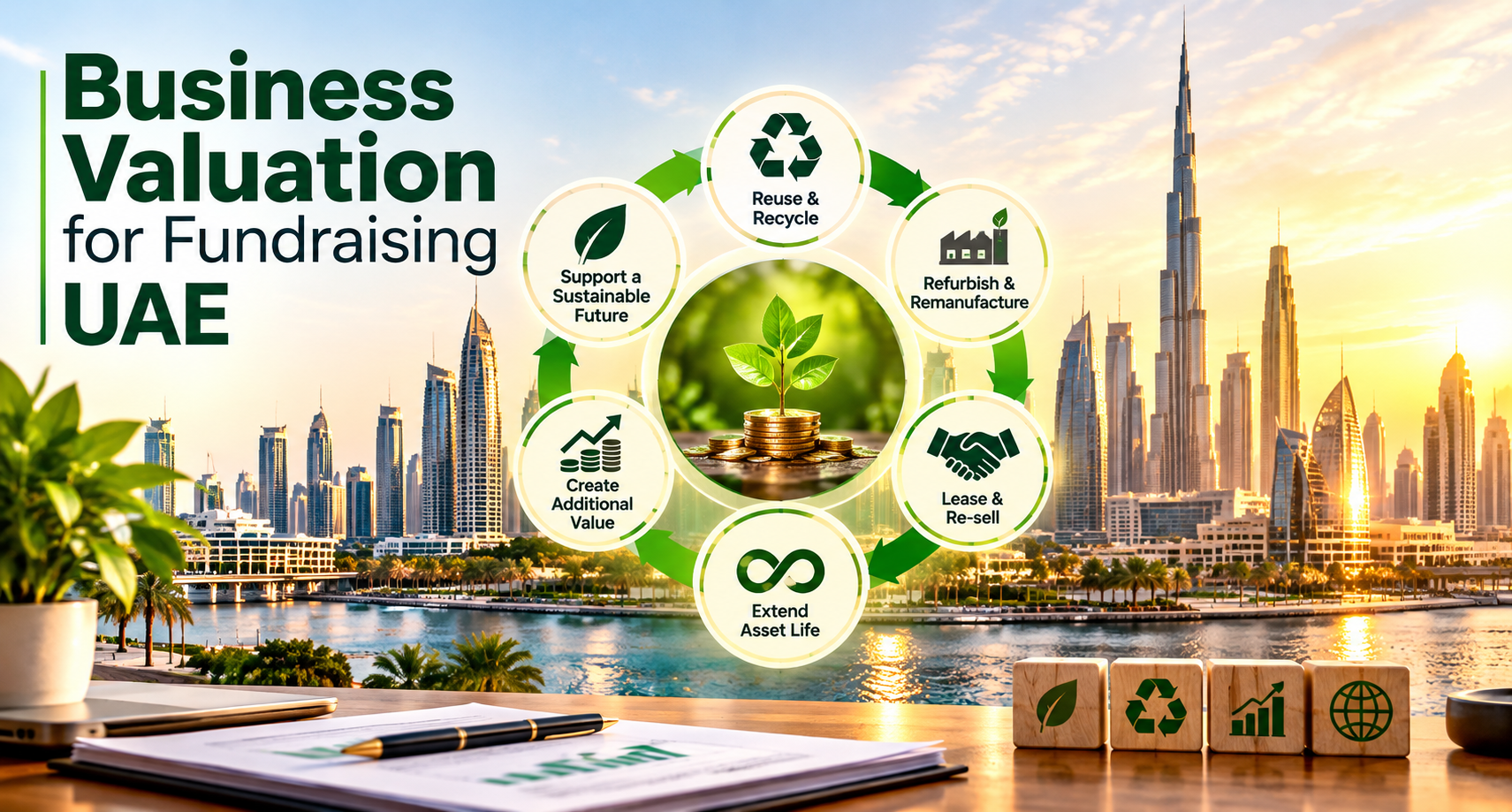
Why residual value, asset recovery and repeat-use economics deserve a place in valuation analysis.
REVIEW KEY: Black text retains the original article’s core ideas. Blue text marks researched additions, expanded analysis and corrections.
Business valuation for fundraising UAE is not only about revenue, profit or market multiples. In businesses built around repair, refurbishment, leasing, resale or material recovery, value may also sit in what happens to an asset after its first use. A circular model can create additional value—but only when realistic cash flows, asset-life assumptions and recoverable value support it.
What Is a Circular Business Model?
Circular business models keep products and materials in use longer through repair, reuse, refurbishment, remanufacturing, leasing, take-back schemes and recycling. Instead of relying only on a first sale, they seek to recover value across multiple life cycles.
The Circularity Gap Report 2025 estimated that secondary materials represented just 6.9% of materials entering the global economy in 2021. This points to opportunities to reduce input costs, create revenue streams and improve supply resilience through material recovery.
Why Residual Value Matters to Valuation
Residual value, or salvage value, is the estimated amount recoverable from an asset at the end of its useful life, after disposal costs. In a circular model, an asset may be refurbished, resold, leased again or remanufactured, making end-of-use value more commercially significant.
Residual value is not an automatic uplift to company worth. It must be supported by asset condition, resale markets, refurbishment costs, recovery rates and disposal costs, and treated consistently under the relevant accounting framework. Analysts must avoid counting resale proceeds twice—in both projected cash flows and asset value.
The key question is whether the company can recover value reliably, at scale and at an attractive economic return.
Case Study 1: Caterpillar’s Remanufacturing Model
Caterpillar’s Cat Reman business shows how industrial components can retain value beyond their first life. The OECD reports that Caterpillar remanufactured more than two million components in 2014, saving an associated 75,400 tonnes of material. Remanufactured products can be sold below new-product prices while offering an equivalent warranty.
For valuation, recovered components may create a second revenue stream and improve material efficiency. Analysts should examine recovery rates, labour and testing costs, warranty claims, resale prices, turnaround time and demand. The financial benefit depends on whether the value recovered from used components exceeds the costs of collection, inspection, remanufacturing, warranty and distribution.
Case Study 2: Philips and Refurbished Medical Equipment
The Ellen MacArthur Foundation reported that circular products and services accounted for 18% of Philips' revenue in 2022. This illustrates how circular business models can become part of a company's broader commercial strategy, rather than remaining a standalone refurbishment initiative.
Philips’ Lumea case study also describes how standardised inspection, cleaning, testing and repackaging supported rental refurbishment. It demonstrates that second-life value depends on quality control and reverse logistics—not just an assumed resale price.
How Circularity Can Affect a Fundraising Valuation
For a company seeking capital, circularity may influence several parts of the valuation story:
Revenue durability: leasing, servicing, repair and refurbishment can create repeat or contracted revenue beyond the initial sale.
Margin potential: recovered materials and refurbished products may lower input costs, but savings must exceed collection, inspection, repair, storage and warranty costs.
Capital intensity: asset ownership in leasing models can support recurring revenue but also requires upfront investment, maintenance and working capital.
Risk and resilience: recovered components can reduce supply exposure, while creating dependencies on returns, reverse logistics and secondary-market demand.
Asset and cash-flow assumptions: defensible residual values can affect depreciation and future cash flows, but must be evidence-based.
During fundraising, investors typically examine historical financial performance, unit economics, asset ownership and condition, working-capital requirements, capital expenditure, cash-flow projections and the evidence behind recovery assumptions. For circular businesses, that evidence may include utilisation, return rates, refurbishment yield, resale prices, downtime, service costs and customer retention.
The Investor Context Is Growing
A 2025 World Economic Forum, Bain & Company and University of Cambridge report surveyed 420 executives across 10 manufacturing industries. About 75% considered circularity important or extremely important, up from 40% three years earlier. Respondents linked circularity to growth, resilience and cost reduction.
This signals growing strategic attention, not proof of higher valuation multiples. Multiples still depend on growth, profitability, risk, capital needs and evidence of future performance.
Why This Matters in the UAE
The UAE’s Circular Economy Policy 2021–2031 prioritises sustainable manufacturing, transport, infrastructure and food production, and encourages resource efficiency, reuse and remanufacturing. Operation 300bn also aims to strengthen the UAE’s industrial base and local value creation. This makes circularity relevant to asset-heavy businesses such as equipment leasing, manufacturing, logistics and fleet services, where asset life and recovery can affect returns.
During fundraising, investors typically examine historical financial performance, unit economics, asset ownership and condition, working capital, capital expenditure, cash-flow projections and the evidence behind recovery assumptions. For asset-heavy companies, they will also test utilisation, return rates, refurbishment yield, resale prices, downtime, service costs and customer retention.
Founders should substantiate recovery assumptions with inspection data, refurbishment costs, warranty experience and realised resale prices. A robust company valuation UAE process should test these assumptions against market evidence and make uncertainty visible.
For early-stage businesses, Startup Valuation Services in Dubai should consider traction, unit economics and the maturity of the business model. A promising circular concept should not be valued as though projected recovery rates and resale margins are already proven.
For founders and valuation professionals, the task is to translate circularity into measurable economics: realistic asset lives, defensible residual values, recovery costs, repeat revenue and risk-adjusted cash flows. When supported by evidence, residual value becomes part of a credible explanation of how the business creates and retains value.
Research and Case-Study References
Circle Economy and Deloitte, Circularity Gap Report 2025 — global secondary-material share. https://www.circularity-gap.world/2025
OECD, Business Models for the Circular Economy — Caterpillar remanufacturing case study. https://www.oecd.org/en/publications/business-models-for-the-circular-economy_g2g9dd62-en/full-report/component-10.html
Ellen MacArthur Foundation, Pioneering Circularity in the Healthcare Industry: Royal Philips. https://www.ellenmacarthurfoundation.org/circular-examples/pioneering-circularity-in-the-healthcare-industry-royal-philips
Ellen MacArthur Foundation, Building a Circular Supply Chain — Philips Lumea rental/refurbishment case study. https://content.ellenmacarthurfoundation.org/m/3678c4e51544ee1b/original/Building-a-Circular-Supply-Chain.pdf
World Economic Forum, Bain & Company and University of Cambridge, Circular Transformation of Industries: Unlocking Economic Value (2025). https://www.weforum.org/publications/circular-transformation-of-industries-unlocking-economic-value/
UAE Government, UAE Circular Economy Policy 2021–2031. https://uaelegislation.gov.ae/en/policy/details/sy-s-dol-l-m-r-t-laarby-lmthd-ll-kts-d-ld-ry-2021-2031
UAE Ministry of Industry and Advanced Technology, Operation 300bn industrial strategy. https://www.moiat.gov.ae/en/about-us/about-the-strategy
Clybourne Insights, Startup Valuation UAE. https://clybourneinsights.com/startup-valuation-uae
Clybourne Insights, Business Valuation Dubai. https://clybourneinsights.com/business-valuation-dubai