Blog
The Discount No One Sees Coming: Why a Great Business Can Still Be Worth Less on Paper
Author -

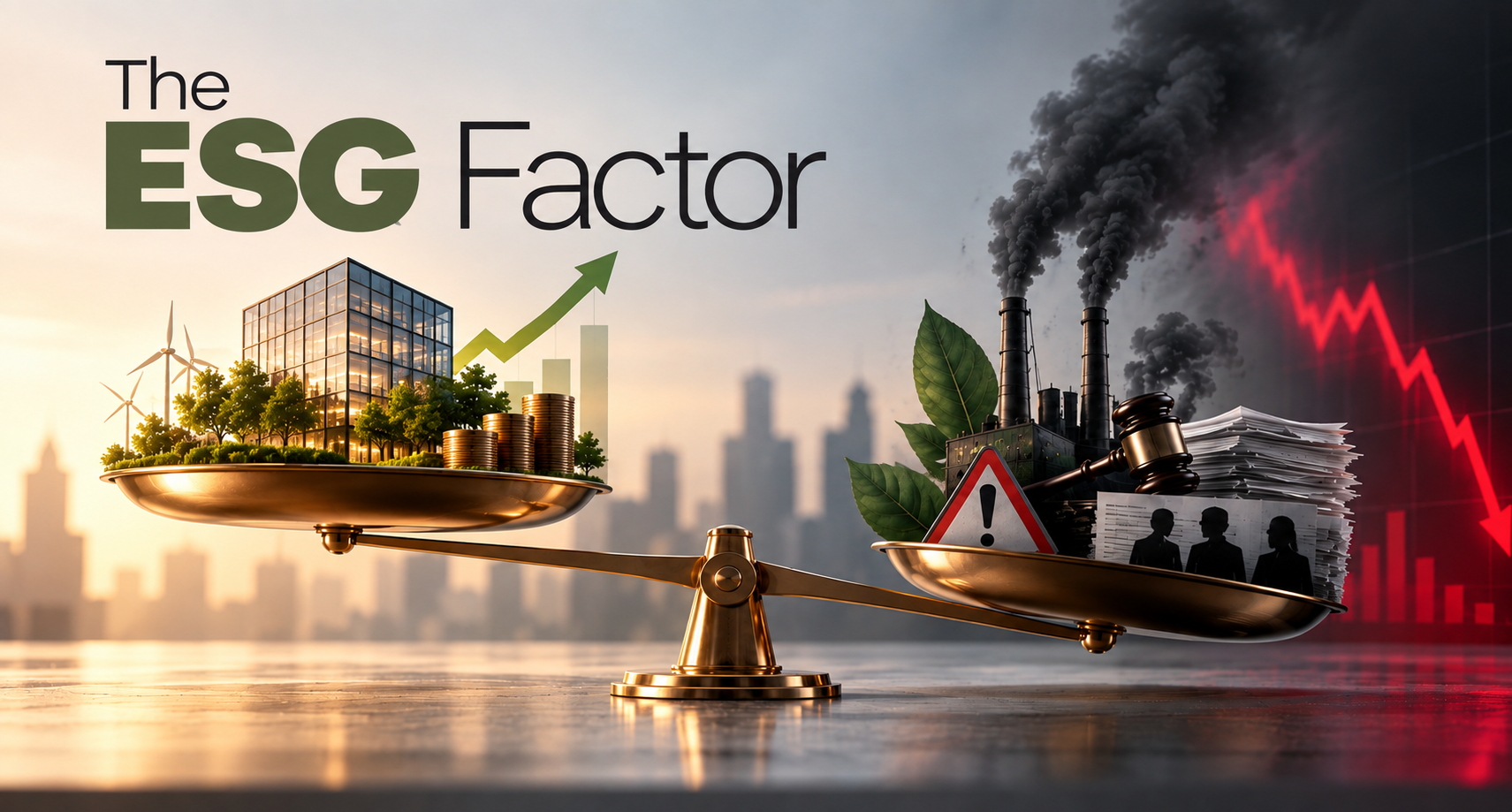
Why ESG risk belongs in valuation—not as a checkbox, but as a business risk.
On September 18, 2015, Volkswagen looked like one of the best-run companies in the world: the largest carmaker on the planet, strong margins, and a reputation for engineering discipline.
Three days later, its stock had dropped 23% in a single session, wiping out roughly $17.6 billion in market value. The eventual bill topped $30 billion.
Nothing had changed about how many cars Volkswagen sold. What changed was that the market discovered the company had spent years hiding software designed to cheat emissions tests—and that the governance systems around it had failed to catch the problem.
This wasn't a bad quarter. It was a risk sitting inside the business long before it appeared in the financial numbers.
That is the valuation problem ESG analysis is designed to help surface: risks that may not be visible in historical earnings, but can affect future cash flows, required returns, liabilities, reputation, access to capital, and ultimately value.
Why This Risk Hides in Plain Sight
Financial statements are largely backward-looking. They tell you what the business has already earned, spent, owned and owed. They do not automatically tell you whether a regulatory issue is building, whether a board is challenging management effectively, or whether a workforce problem is likely to become a costly dispute.
An environmental liability, weak safety culture, poor data controls or ineffective governance can therefore remain financially quiet until a trigger makes the cost visible.
ESG analysis closes part of that gap by asking a practical valuation question: could an environmental, social or governance factor materially affect the company's economics?
That is different from treating ESG as a scorecard of whether a company is 'good' or 'bad'. The relevant issue for valuation is whether a factor creates a measurable risk or opportunity.
What Actually Gets Assessed
ESG covers three distinct categories:
Environmental — emissions, resource use, waste, pollution, climate exposure, environmental regulation and resource efficiency.
Social — labour practices, health and safety, customer relationships, data privacy, human capital and community relations.
Governance — board structure, ownership, executive incentives, transparency, compliance, ethics controls, succession planning and oversight.
The International Valuation Standards Council (IVSC) notes that ESG factors can affect valuation both qualitatively and quantitatively and may represent risks or opportunities. IVS, effective 31 January 2025, includes an appendix under IVS 104 addressing ESG considerations.
A Simple Example: The Same EBITDA, Different Risk
Consider two companies in the same industry. Both generate ₹20 crore of EBITDA and have similar growth rates.
Company A has documented compliance systems, independent oversight and a clear process for identifying operational risks.
Company B has recurring regulatory issues, weak internal controls and limited evidence of risk mitigation.
A mechanical comparable-company approach could treat them as identical because the headline financial numbers look similar.
A deeper valuation analysis may not.
If Company B's risk profile means investors require a higher return, or if a potential regulatory liability affects expected cash flows, its value can be lower even before the liability appears as a large accounting charge.
The important point is not that ESG automatically creates a discount. It is that material ESG-related risk can change the assumptions used to arrive at value.
Case Study: Volkswagen
Volkswagen shows how a governance failure can amplify an environmental issue.
The emissions issue was environmental. The mechanism that allowed it to persist was also a governance problem. The market reaction reflected the combined consequences: regulatory exposure, legal costs, reputational damage and questions about internal oversight.
The original financial performance did not suddenly explain the new valuation. New information changed expectations about future costs and risk.
This is why ESG categories should not always be assessed in isolation. A clean environmental record cannot compensate for a serious governance weakness if that weakness is capable of creating a material financial exposure.
Why the Highest Risk Matters
A simple ESG average can hide the issue that matters most.
Imagine a company with strong environmental practices, good employee policies and a major governance weakness involving compliance. Giving each category an equal score could produce an attractive overall average while masking the most financially significant risk.
For valuation, the more useful question is: which identified factor could have the greatest impact on value?
That factor may influence the analysis through expected cash flows, liabilities, growth assumptions, capital expenditure, discount rates or a company-specific risk premium.
This risk-based approach is consistent with the underlying logic of valuation: material factors should influence the assumptions they actually affect, rather than being reduced to a generic ESG score.
ESG Is Not Just for Large Listed Companies
The same logic applies to private companies.
A private manufacturing company may face environmental compliance costs. A technology company may face data privacy and cybersecurity risks. A healthcare business may face patient-safety or regulatory exposure. A founder-led company may have concentrated decision-making and limited succession planning.
None of these issues automatically means the business is worth less. The valuation question is whether the exposure is material, how likely it is to affect the business, and whether the company has credible mitigation measures.
This is particularly relevant during acquisitions, fundraising, shareholder transactions, lending decisions and financial reporting, where an apparently strong business can attract additional scrutiny.
How ESG Can Flow Into a Valuation
There is no single ESG adjustment that works for every company. The impact depends on the business and the evidence available.
A material ESG factor may affect:
• Forecast cash flows — through higher costs, penalties, remediation, lost customers or operational disruption.
• Growth assumptions — if regulation, customer behaviour or resource constraints affect future demand.
• Capital expenditure — where additional investment is required for compliance, safety, energy efficiency or risk mitigation.
• Discount rates or company-specific risk premiums — where the identified risk changes the return investors would reasonably require.
• Terminal value — where a structural environmental, social or governance issue affects the long-term sustainability of the business.
The goal is not to force an ESG adjustment into a model. It is to identify where the evidence belongs in the valuation.
The Data Problem
One reason ESG is often treated as an afterthought is that the data is not always clean or comparable.
The IVSC's 2024 global survey collected responses from 542 valuation professionals across 85 countries. It found that approaches to ESG integration vary across markets and that data reliability, comparability and practical quantification remain important challenges. citeturn0search4
That makes professional judgement important. A valuation should distinguish between a disclosed, measurable exposure and a broad assumption based on a generic ESG label.
In other words: evidence first, adjustment second.
What a Valuer Should Ask
A practical ESG assessment can start with a small set of questions:
1. What ESG risks are inherent in this industry?
2. Has the company disclosed any relevant compliance issues, disputes or controversies?
3. What policies and controls exist to mitigate those risks?
4. Is there evidence that those controls actually operate?
5. Could the identified risk affect cash flows, growth, investment requirements or required returns?
6. Is the available information reliable enough to support a valuation adjustment?
These questions keep ESG connected to valuation rather than turning the exercise into a generic sustainability checklist.
How Clybourne Applies This
Clybourne incorporates ESG into its Company-Specific Risk Premium assessment, using industry-level exposure, disclosed compliance issues and risk-mitigation practices based on company disclosures and industry classification.
The approach focuses on the most significant identified factor rather than simply averaging environmental, social and governance categories. The intent is to prevent a material, specific exposure from being diluted by strengths in unrelated areas.
That approach also reflects a broader principle: valuation should be driven by factors that can reasonably affect economic value, not by labels.
The Bottom Line
A business can look financially strong and still carry risks that the headline numbers do not capture.
Volkswagen is a powerful example because the underlying issue existed before the market repriced the company. The financial impact arrived after the risk became visible.
That is why ESG belongs in valuation when it is material and supported by evidence.
The question isn't whether a company has a perfect ESG profile.
The question is: **What risks exist, how significant are they, and how could they affect value?**
A risk that hasn't hit the financial statements yet is still a risk. The absence of a visible cost today does not guarantee the absence of a cost tomorrow.
PREVIOUS POST
None
Speak With a Valuation Specialist
Speak With a Valuation Specialist
Pick a 30-minute slot to discuss your valuation objective, report scope, and the right engagement tier.